
Programme Overview
Information Technology is one of the key strategic training programmes of the Posts and Telecommunications Institute of Technology, belonging to the group of cutting-edge technologies in the STEM field. The programme is designed to train human resources with a solid foundation of knowledge, in-depth professional skills, and research and innovation capabilities to meet the rapidly developing demands of the digital economy. In the Institute's development strategy, Information Technology plays a core role in training talented engineers, bachelors, and masters, and serves as a foundation for interdisciplinary fields such as Artificial Intelligence, Data Science, Information Security, Software Engineering, Multimedia Technology, and FinTech.
With an objective of linking training with research and practical application, the Information Technology faculty of the Institute has been providing thousands of high-quality engineers, bachelors, and master graduates to domestic and international technology corporations and businesses such as VNPT, Viettel, FPT, Samsung, Toshiba, IBM, Rikkeisoft, NashTech, etc. Many alumni of the Institute currently hold important positions in organizations, businesses, and state management agencies, making significant contributions to the development of Vietnam's IT industry.
With its strong tradition, training capacity, highly qualified lecturers, and development orientation aligned with the national digital transformation strategy, the Information Technology programme at the Posts and Telecommunications Institute of Technology is fully qualified, capable, and reputable to implement the Information Technology Engineering programme, contributing to the training of a generation of outstanding technology experts and technical leaders to serve Vietnam's socio-economic development and international integration.
Programme Learning Outcomes
The programme's learning outcomes (PLOs), competency levels, and performance indicators (PIs) are as follows:
| Programme Outcomes (PLOs) | Competency level* | Performance indicators (PIs) |
|---|---|---|
| PLO1. Identify problems and possible solutions IT-related issues. | C4 | 1.1 Identify the problem and its requirements. |
| C4/P3 | 1.2 Analyze computing solutions to solve the problem. | |
| C4/P3 | 1.3 Select appropriate solution based on the principles of computing. | |
| PLO2. Communicate effectively in a variety of professional contexts.) | C3/P3 | 2.1 Demonstrates effective written communication skills in the context of discussion topics. |
| C3/P3 | 2.2 Effectively presents concepts in oral presentation. | |
| PLO3. Recognize professional responsibilities and make informed judgments in computing based on legal and ethical principles. | C3/P3 | 3.1 Apply legal and ethical principles when resolving professional issues. |
| C3/A3 | 3.2 Demonstrates awareness of the significance of privacy, security, copyright in computing. | |
| PLO4. Function effectively as a member or leader of a team engaged in activities appropriate to the programme's discipline. | A2 | 4.1 Collaboration and work sharing in a team of computing domain. |
| P3 | 4.2 Work as a member of any role in a team of computing domain. | |
| PLO5. Realize one phase of IT-based project development process. | C6 | 5.1. Design a solution for the current phase. |
| L3 | 5.2. Realize the selected solution for the current phase |
Curriculum Structure
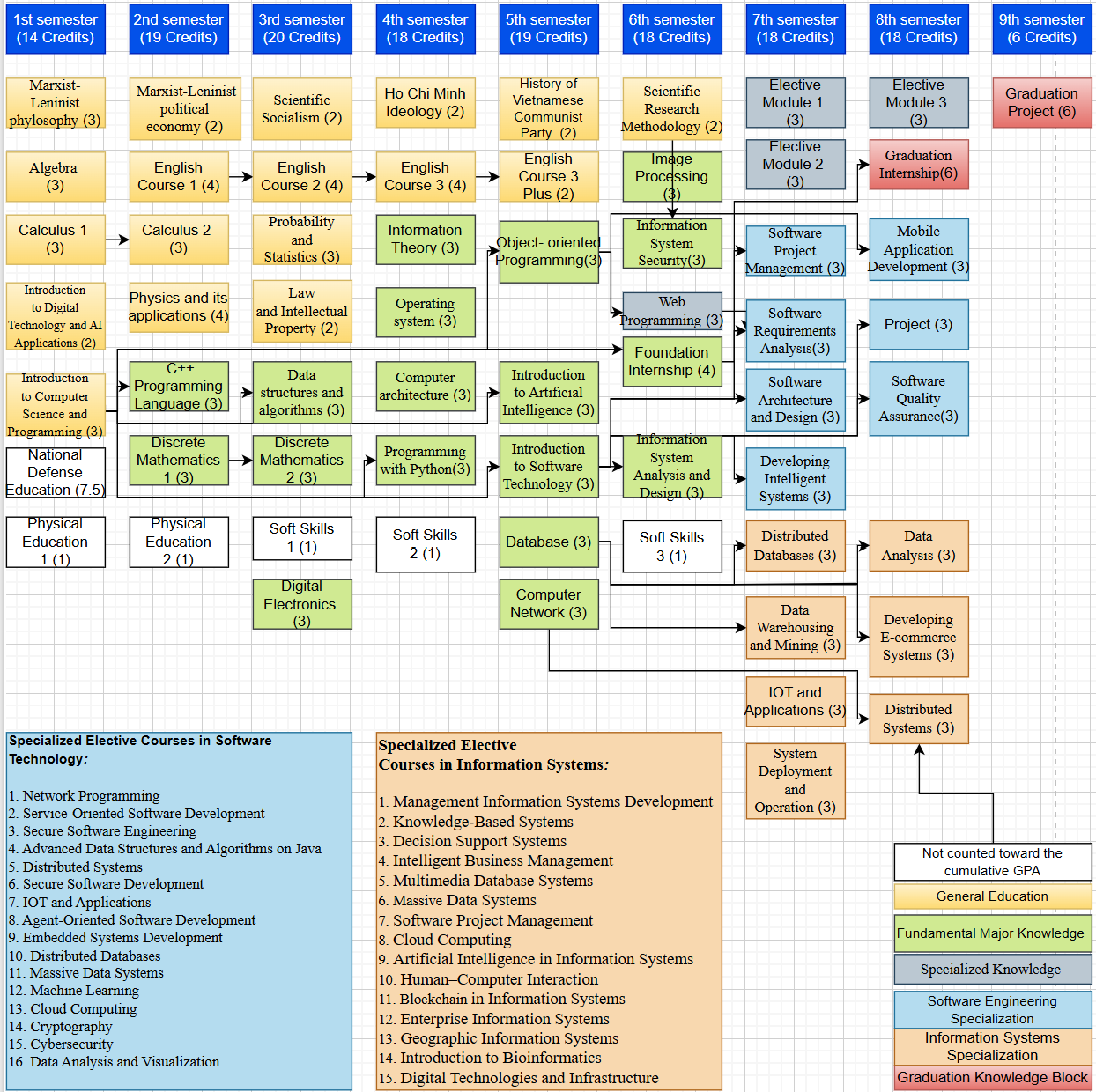
Course Matrix
| PLOs | PLO1 | PLO2 | PLO3 | PLO4 | PLO5 | ||||||||||
| [i] | [ii] | [iii] | [i] | [ii] | [iii] | [i] | [ii] | [iii] | [i] | [ii] | [iii] | [i] | [ii] | [iii] | |
| COURSES IN THE CURRICULUM | Direct/ Indirect (X, Y) | Level of mention of the outcome (I, R, E) | Assessment (A) | Direct/Indirect (X, Y) | Level of mention of the outcome (I, R, E) | Assessment (A) | Direct/Indirect (X, Y) | Level of mention of the outcome (I, R, E) | Assessment (A) | Direct/Indirect (X, Y) | Level of mention of the outcome (I, R, E) | Assessment (A) | Direct/Indirect (X, Y) | Level of mention of the outcome (I, R, E) | Assessment (A) |
| Marxist-Leninist Philosophy | Y | I | |||||||||||||
| Calculus 1 | Y | I | |||||||||||||
| Algebra | Y | I | |||||||||||||
| Introduction to Digital Technology and AI Applications | Y | I | |||||||||||||
| Introduction to Computer Science and Programming | X | I | |||||||||||||
| Physical Education 1 | |||||||||||||||
| National Defense Education | |||||||||||||||
| Marxist-Leninist Political Economy | Y | I | |||||||||||||
| English Course 1 | Y | I | Y | I | |||||||||||
| Calculus 2 | Y | I | |||||||||||||
| Physics and Applications | Y | I | |||||||||||||
| Discrete Mathematics 1 | X | I | X | I | |||||||||||
| C++ Programming Language | X | I | |||||||||||||
| Physical Education 2 | |||||||||||||||
| Scientific Socialism | Y | I | |||||||||||||
| English Course 2 | Y | I | Y | I | |||||||||||
| Probability and Statistics | Y | I | |||||||||||||
| Law and Intellectual Property | X | I | |||||||||||||
| Discrete Mathematics 2 | X | I | X | I | |||||||||||
| Digital Electronics | X | I | |||||||||||||
| Data Structures and Algorithms | X | I | X | I | |||||||||||
| Soft Skills 1 | X | I | X | I | |||||||||||
| Ho Chi Minh Ideology | Y | I | |||||||||||||
| English Course 3 | Y | I | Y | I | |||||||||||
| Computer Architecture | X | I | X | I | |||||||||||
| Operating System | X | I | A | X | I | A | |||||||||
| Information Theory | X | I | |||||||||||||
| Programming with Python | X | I | X | I | |||||||||||
| Soft Skills 2 | X | I | X | I | |||||||||||
| History of the Communist Party of Vietnam | Y | I | |||||||||||||
| English Course 3 Plus | Y | I | Y | I | |||||||||||
| Introduction to Software Engineering | X | I | X | R | |||||||||||
| Introduction to Artificial Intelligence | X | R | |||||||||||||
| Computer Network | X | R | A | X | I | A | |||||||||
| Object-Oriented Programming | X | R | X | R | |||||||||||
| Database | X | R | X | R | |||||||||||
| Soft Skills 3 | X | I | X | I | |||||||||||
| Scientific Research methodology | X | I | X | I | |||||||||||
| Information System Security | X | R | X | R | |||||||||||
| Image Processing | X | R | A | ||||||||||||
| Information System Analysis and Design | X | R | X | R | |||||||||||
| Foundation Internship | X | R | A | X | R | A | X | R | A | X | R | A | |||
| Web Programming | X | R | A | X | E | A | |||||||||
| Software Project Management | X | R | A | X | R | A | X | R | A | ||||||
| Software Requirements Analysis | X | E | X | R | X | E | |||||||||
| Software Architecture and Design | X | E | X | R | X | E | |||||||||
| Developing Intelligent Systems | X | E | X | R | X | E | |||||||||
| Elective Course 1 | |||||||||||||||
| Elective Course 2 | |||||||||||||||
| Distributed Databases | X | E | X | E | |||||||||||
| IoT and Applications | X | E | X | E | |||||||||||
| System Deployment and Operation | X | E | X | E | |||||||||||
| Data Warehousing and Mining | X | E | A | X | E | A | |||||||||
| Elective Course 1 | |||||||||||||||
| Elective Course 2 | |||||||||||||||
| Project | X | E | X | E | X | E | |||||||||
| Software Quality Assurance | X | E | A | X | E | A | X | E | A | ||||||
| Mobile Application Development | X | E | A | X | E | A | X | E | A | ||||||
| Elective Course 3 | |||||||||||||||
| Distributed Systems | X | E | X | E | X | E | |||||||||
| Data Analysis | X | E | X | E | |||||||||||
| E-commerce Systems Development | X | E | A | X | E | A | |||||||||
| Elective Course 3 | |||||||||||||||
| Graduation Internship | X | E | A | X | E | A | X | E | A | X | E | A | X | E | A |
| Graduation Project | X | E | A | X | E | A | X | E | A | X | E | A | X | E | A |
Career Opportunities
Employment opportunities:
After graduation, students can successfully fill the following job positions:
- Technical, managerial, and operational staff in the field of information technology;
- Programmemers, system administrators, information systems design analysts;
- Working on projects as an IT project manager;
- Research staff and lecturers in information technology at research institutes, centers, and training institutions;
It is possible to continue studying at the postgraduate level both domestically and abroad.
Further study opportunities:
After graduation, students can pursue master's programmes in the fields of Information Technology both domestically and abroad.
Admission Requirements
Applicants must be high school graduates or equivalent, participate in and be admitted (meet the entrance requirements) to the regular undergraduate entrance examination with the following subject combinations: Mathematics, Physics, Chemistry (A00); Mathematics, Physics, English (A01); Mathematics, Physics, Informatics (X06); Mathematics, Literature, English (D01); Mathematics, Informatics, English (X26) or other specific admission methods of the Posts and Telecommunications Institute of Technology.
Admission methods
The admission options for the Information Security major are diverse, including admission based on high school graduation exam results, combined admission (English + academic transcript), direct admission for national outstanding students, and admission based on aptitude and thinking skills assessment results. These are implemented according to the Institute 's annual admission plan, which is published on the Institute's admissions website.https://tuyensinh.ptit.edu.vn/4843-2/.
Assessment Strategy
The Information Technology programme adopts an Outcome-Based Education (OBE) assessment approach, in which all assessment activities are aligned with Course Learning Outcomes (CLOs) and Programme Learning Outcomes (PLOs).
Assessment is designed to evaluate students’ achievement in knowledge, professional skills, problem-solving abilities, teamwork, communication, and professional responsibility through a combination of formative and summative assessment methods.
Assessment Methods
A variety of assessment methods are used throughout the programme, including:
- Quizzes and written examinations
- Individual and group assignments
- Laboratory work and practical exercises
- Projects and software development activities
- Technical reports and presentations
- Internships and industry-based learning
- Capstone projects and graduation theses
These methods enable students to demonstrate both theoretical understanding and the ability to apply knowledge in real-world and professional contexts.
Formative and Summative Assessment
The programme combines:
- Formative Assessment – continuous evaluation through assignments, discussions, project milestones, peer feedback, and instructor feedback to support student learning and improvement.
- Summative Assessment – final examinations, project deliverables, capstone projects, and thesis defense activities to evaluate achievement of learning outcomes.
Authentic and Competency-Based Assessment
The programme emphasizes competency-based assessment through practical projects, software products, technical solutions, research activities, and real-world applications.
Students may be assessed through authentic learning environments such as:
- laboratories,
- research groups,
- industry projects,
- and internship placements.
Assessment may involve multiple sources of evaluation, including academic staff, project supervisors, industry mentors, peer review, and self-assessment.
Assessment Quality Assurance
To ensure fairness, transparency, and consistency, assessment activities are supported by:
- clearly defined assessment criteria and rubrics,
- moderation and review processes,
- constructive feedback mechanisms,
- and continuous monitoring of learning outcome achievement.
Assessment results are systematically analyzed and used to support programme review and continuous quality improvement.
Quality Assurance
The Information Technology programme at the Posts and Telecommunications Institute of Technology (PTIT) is implemented within the Institute’s Internal Quality Assurance (IQA) framework and is committed to continuous quality improvement.
The programme applies the principles of Outcome-Based Education (OBE), ensuring alignment between Programme Learning Outcomes (PLOs), curriculum design, teaching and learning activities, and assessment methods. Programme quality is continuously monitored and enhanced through the PDCA (Plan – Do – Check – Act) cycle.
Continuous Improvement
The programme is regularly reviewed and updated every 2–3 years based on:
- student feedback,
- alumni feedback,
- employer feedback,
- learning outcome assessment results,
- technological developments,
- and industry requirements.
Improvement activities include curriculum revision, enhancement of teaching and assessment methods, and the integration of emerging technologies and industry trends into the programme.
Stakeholder Engagement
Stakeholders play an important role in programme development and quality enhancement. Feedback from students, graduates, employers, academic staff, and industry partners is systematically collected and used to support programme review and continuous improvement.
Accreditation and International Standards
The Information Technology programme was accredited according to the national accreditation standards of the Ministry of Education and Training (MOET) in 2023.
The programme is currently implementing quality assurance and improvement activities in preparation for international accreditation according to ASIIN standards, with accreditation planned for 2026.
Through its quality assurance system, the programme aims to ensure that graduates possess strong professional knowledge, practical skills, innovation capability, and the competencies required to succeed in a rapidly evolving digital environment.
Teaching & Learning
The Information Technology programme adopts a student-centered learning approach in which students actively participate in knowledge acquisition, problem-solving, innovation, and lifelong learning. Academic staff serve as facilitators, mentors, and advisors who create an open and collaborative learning environment that encourages independent thinking, creativity, and research-oriented learning.
Teaching and Learning Approaches
The programme employs a combination of modern teaching and learning approaches to support the achievement of Programme Learning Outcomes (PLOs).
Problem-Based Learning (PBL)
Students are engaged in real-world and open-ended problems that require critical thinking, analysis, and solution development. This approach is widely applied in courses such as Data Structures and Algorithms, Database Systems, Machine Learning, and other core computing subjects.
Project-Based Learning (PJBL)
Students participate in individual and team projects that integrate theory with practical applications. Through project development, students enhance their technical competencies, innovation capability, teamwork, leadership, and entrepreneurial mindset. This approach is extensively applied in advanced and practice-oriented courses.
Research-Based Learning (RBL)
Students are encouraged to engage in scientific research, academic seminars, innovation projects, and graduation thesis activities. Research-based learning helps students develop critical thinking, independent learning skills, and the ability to create new knowledge and technological solutions.
Experiential and Industry-Oriented Learning
The programme emphasizes experiential learning through:
- laboratory activities,
- software development projects,
- internships,
- industry collaboration,
- and research activities.
These learning experiences enable students to apply knowledge in professional contexts and develop competencies required by the digital economy and technology industry.
Learning Environment
The programme provides an interactive learning environment that promotes collaboration between students and academic staff. Small-class teaching is applied in selected advanced and talent-oriented courses to enhance interaction, personalized learning, and academic mentoring.
Graduate Competency Development
Through these teaching and learning approaches, students are expected to develop:
- strong computing and engineering knowledge,
- problem-solving and innovation capabilities,
- teamwork and communication skills,
- research competencies,
- professional responsibility,
- and lifelong learning abilities.
Graduate Outcomes
Will be added


