
Programme Overview
Information Security is one of the Institute’s key academic programmes and forms part of the core STEM disciplines. The programme is designed to develop high-quality human resources with solid foundational knowledge, advanced professional skills, and research and innovation capacity, in order to meet the rapidly evolving demands of the digital economy. Within the Institute’s overall development strategy, the Information Security programme plays a crucial role in supplying highly qualified professionals to ensure the security of information, information systems, and cyberspace in the context of comprehensive national digital transformation.
With a strong orientation towards the integration of education, research, and practical application, the Information Security programme at PTIT has trained and supplied thousands of Information Security engineers to major technology corporations, enterprises, and financial institutions at both national and international levels, including telecommunications groups, technology firms, cybersecurity companies, and commercial banks. Many alumni of the Institute currently hold key positions in enterprises, organisations, and state management agencies, making significant contributions to ensuring cybersecurity and cyber safety in Viet Nam.
Benefiting from a long-standing tradition, strong training capacity, a highly qualified academic staff, and a development orientation closely aligned with the national digital transformation strategy, the Information Security programme at the Posts and Telecommunications Institute of Technology possesses sufficient conditions, capabilities, and reputation to effectively deliver the Information Security Engineering programme. The programme aims to educate a new generation of outstanding technical experts and future technical leaders, contributing to Viet Nam’s socio-economic development and international integration.
Programme Learning Outcomes
The Programme learning outcomes, competence levels, and performance indicators of the programme are defined as follows:
| Programme Learning Outcomes (PLOs) | Competence Level* | Performance Indicators (PIs) |
|---|---|---|
| PLO1: Analyse complex problems and apply computing theories and other relevant disciplinary knowledge to identify appropriate solutions. | C4 / P3 | 1.1 Formulate the problem and its requirements. 1.2 Analyse computational solutions to solve the problem. 1.3 Select appropriate solutions based on computational principles. |
| PLO2: Communicate effectively in a variety of professional contexts. | C3 / P3 | 2.1 Demonstrate effective written communication skills in discussion contexts. 2.2 Present issues effectively through oral presentations. |
| PLO3: Recognise professional responsibilities and make sound judgements in security practices based on legal and ethical principles. | C3 / P3 / A2 | 3.1 Apply legal principles and professional ethics in addressing profession-related issues. 3.2 Demonstrate awareness of the importance of privacy and security in data management. |
| PLO4: Function effectively as a member or leader of a team engaged in information security-related activities. | P3 / A2 | 4.1 Coordinate and share tasks within a team. 4.2 Accomplish assigned tasks in different team roles. |
| PLO5: Apply security techniques, technologies, and tools to maintain system operations in the presence of information security risks and threats. | C3 / P3 | 5.1 Identify security risks and threats to system operations. 5.2 Select appropriate security techniques, technologies, and tools to mitigate risks and threats. 5.3 Implement selected mitigation techniques, technologies, and tools to maintain system operations. |
| PLO6: Design, implement, and evaluate security solutions for systems that meet a defined set of requirements. | C6 / P4 | 6.1 Design system security solutions based on a defined set of requirements. 6.2 Implement the designed security solutions. 6.3 Evaluate the implemented security solutions. |
Curriculum Structure
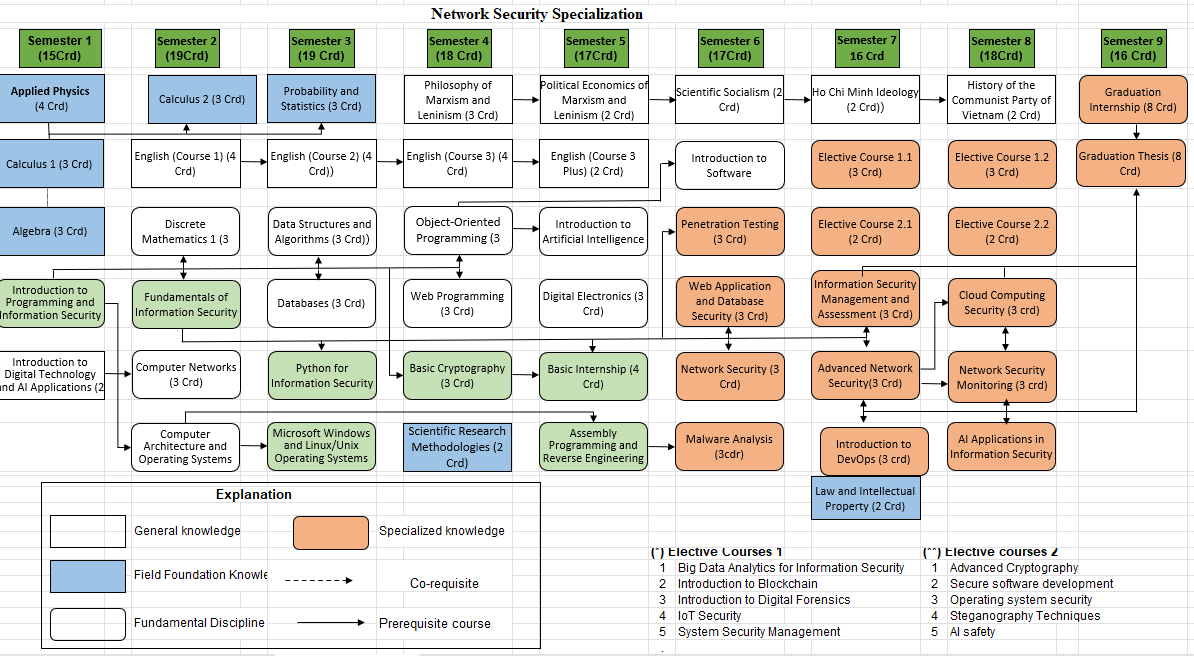
Course Matrix
| PLO1 | PLO2 | PLO3 | PLO1 | PLO5 | PLO6 | |||||||||||||
| COURSES | [i] Direct/Indirect (X, Y) | [ii] Level of PLO (I, R, E) | [iii] Assessment (A) | [i] Direct/Indirect (X, Y) | [ii] Level of PLO (I, R, E) | [iii] Assessment (A) | [i] Direct/Indirect (X, Y) | [ii] Level of PLO (I, R, E) | [iii] Assessment (A) | [i] Direct/Indirect (X, Y) | [ii] Level of PLO (I, R, E) | [iii] Assessment (A) | [i] Direct/Indirect (X, Y) | [ii] Level of PLO (I, R, E) | [iii] Assessment (A) | [i] Direct/Indirect (X, Y) | [ii] Level of PLO (I, R, E) | [iii] Assessment (A) |
| Algebra | Y | I | ||||||||||||||||
| Calculus 1 | Y | I | ||||||||||||||||
| Introduction to CNS and AI Applications | Y | I | ||||||||||||||||
| Introduction to Programming and Information Security | X | I | ||||||||||||||||
| Applied Physics | Y | I | X | I | ||||||||||||||
| English (Course 1) | Y | I | ||||||||||||||||
| Calculus 2 | Y | I | ||||||||||||||||
| Discrete Mathematics 1 | Y | I | ||||||||||||||||
| Computer network | Y | I | ||||||||||||||||
| Computer architecture and operating systems | Y | I | ||||||||||||||||
| Information security foundation | X | I | X | I | X | I | ||||||||||||
| English (Course 2) | Y | I | ||||||||||||||||
| Probability and Statistics | Y | I | ||||||||||||||||
| Data structures and algorithms | Y | I | ||||||||||||||||
| Database | Y | R | ||||||||||||||||
| Python for Information Security | X | R | A | X | I | X | I | |||||||||||
| Windows and Linux/Unix operating systems | X | R | A | X | I | X | I | |||||||||||
| Marxist-Leninist Philosophy | Y | I | ||||||||||||||||
| English (Course 3) | Y | R | ||||||||||||||||
| Object-Oriented Programming | Y | R | ||||||||||||||||
| Web programming | Y | R | ||||||||||||||||
| Basic Cryptography | X | R | A | X | I | X | I | X | R | A | ||||||||
| Research methodology | Y | I | ||||||||||||||||
| Presentation skills | Y | I | ||||||||||||||||
| Marxist-Leninist Political Economy | Y | I | ||||||||||||||||
| English (Course 3 plus) | Y | R | ||||||||||||||||
| Digital Electronics | Y | I | ||||||||||||||||
| Introduction to Artificial Intelligence | Y | R | ||||||||||||||||
| Assembly language and reverse translation | X | E | A | X | I | X | I | X | R | A | ||||||||
| Internship | X | E | A | X | R | A | X | I | ||||||||||
| Teamwork skills | Y | I | ||||||||||||||||
| Scientific socialism | Y | I | ||||||||||||||||
| Introduction to Software Engineering | Y | R | ||||||||||||||||
| Web application and database security | Y | R | X | R | A | X | R | A | ||||||||||
| Network security | Y | R | X | R | A | X | R | X | R | A | ||||||||
| Malware analysis | X | R | A | X | R | A | Y | E | ||||||||||
| Penetration testing | X | R | A | X | R | A | X | R | A | |||||||||
| Text creation skills | Y | I | ||||||||||||||||
| Ho Chi Minh Ideology | Y | I | ||||||||||||||||
| Information security management and assessment | X | R | A | X | E | A | Y | R | ||||||||||
| Introduction to DevOps | X | R | A | X | E | A | X | R | A | |||||||||
| Enhanced cybersecurity | X | R | A | X | R | A | X | R | A | |||||||||
| Introduction to Blockchain | X | R | A | X | E | A | X | R | A | |||||||||
| Smart contract programming | X | R | A | X | R | A | X | R | A | |||||||||
| Introduction to Digital Surveying | X | R | A | X | E | A | X | R | A | |||||||||
| Computer-aided numerical investigation | X | R | A | X | R | A | X | R | A | |||||||||
| Elective Course 1.1 | Y | R | Y | R | X | E | A | |||||||||||
| Elective course 2.1 | Y | R | Y | R | Y | E | ||||||||||||
| Law and intellectual property | Y | I | ||||||||||||||||
| History of Vietnamese Communist Party | Y | I | ||||||||||||||||
| Network security monitoring | Y | R | X | E | A | X | E | A | ||||||||||
| Cloud computing security | X | E | A | Y | R | X | E | A | ||||||||||
| Blockchain Security | Y | R | X | E | A | X | E | A | ||||||||||
| Decentralized application development | X | E | A | Y | R | X | E | A | ||||||||||
| Online digital investigation | Y | R | X | E | A | X | E | A | ||||||||||
| Incident response and handling | X | E | A | Y | R | X | E | A | ||||||||||
| AI applications in information security. | X | E | A | X | E | X | E | A | ||||||||||
| Elective course 1.2 | Y | R | Y | R | X | E | A | |||||||||||
| Elective course 2.2 | Y | R | Y | R | Y | E | ||||||||||||
| Graduation internship | X | E | A | X | E | A | X | E | A | X | E | A | ||||||
| Graduation project | X | E | A | X | E | A | X | E | A | X | E | A | X | E | A | X | E | A |
| RESULTS (i) | ||||||||||||||||||
Career Opportunities
Employment opportunities
Graduates may undertake positions such as technical staff, managers, and administrators in the fields of information security, information technology, and information systems; network and system security administrators; information security analysts, consultants, designers, auditors, vulnerability assessment specialists; digital forensics and incident response specialists; software developers for secure systems and blockchain-based applications; researchers and lecturers in information security, information technology, and information systems; or pursue postgraduate studies domestically and internationally.
Further Study Opportunities
Graduates may continue their studies at postgraduate level in Viet Nam or abroad.
Admission Requirements
Applicants must have graduated from upper secondary school (or an equivalent qualification) and have successfully met the admission requirements of the regular full-time undergraduate intake. Eligible applicants are admitted through the following admission subject combinations: Mathematics–Physics–Chemistry (A00); Mathematics–Physics–English (A01); Mathematics–Physics–Informatics (X06); Mathematics–Literature–English (D01); Mathematics–Informatics–English (X26), or other specific admission schemes stipulated by the Academy of Posts and Telecommunications Technology.
Assessment Strategy
Assessment Philosophy
The Information Security programme adopts an Outcome-Based Education (OBE) assessment approach. Assessment activities are designed to measure the achievement of Programme Learning Outcomes (PLOs) and Course Learning Outcomes (CLOs) through competency-based evaluation methods.
Assessment Methods
A variety of assessment methods are used throughout the programme, including:
- Objective tests and quizzes
- Essay examinations
- Laboratory assessments
- Projects and case studies
- Research presentations
- Internship reports
- Self-assessment and peer assessment
- Graduation projects and theses
These methods evaluate students’ knowledge, technical competencies, analytical skills, teamwork, communication abilities, and professional responsibility.
Constructive Alignment
Assessment methods are aligned with programme learning outcomes and designed to evaluate different competency levels according to Bloom’s taxonomy.
Students are assessed through authentic and practical learning activities, including:
- cybersecurity projects,
- security audits,
- penetration testing exercises,
- digital forensics investigations,
- and applied research activities.
Feedback and Quality Assurance
Students receive timely feedback through:
- course assessments,
- PTIT-Slink,
- learning management systems,
- and academic advising activities.
Assessment processes are supported by:
- question banks,
- assessment rubrics,
- examination moderation,
- re-evaluation procedures,
- and institutional quality assurance regulations
Quality Assurance
Overview
The Information Security programme at the Posts and Telecommunications Institute of Technology (PTIT) is designed in accordance with international educational standards, ensuring alignment between programme objectives, learning outcomes, curriculum structure, course content, teaching methods, and assessment strategies.
The programme is delivered through a blended learning model combining face-to-face and online instruction. It is developed based on Programme Learning Outcomes (PLOs), Performance Indicators (PIs), curriculum mapping, and Bloom’s taxonomy.
Continuous Quality Improvement
The programme applies the PDCA (Plan – Do – Check – Act) cycle to support continuous improvement.
Programme enhancement activities are based on:
- student feedback,
- alumni feedback,
- employer feedback,
- learning outcome assessment results,
- and industry requirements.
Recent curriculum updates have incorporated emerging topics such as:
- Cybersecurity,
- Blockchain Applications,
- Digital Forensics,
- Artificial Intelligence in Information Security,
- IoT Security,
- Cloud Security,
- and Big Data Analytics for Cybersecurity.
Stakeholder Engagement
The programme regularly collects feedback from:
- employers,
- industry experts,
- academic staff,
- alumni,
- and students.
Stakeholder feedback is systematically analyzed and used to review and improve programme learning outcomes, curriculum content, teaching methods, and student support services.
Programme Review and Accreditation
Programme Learning Outcomes and curriculum structure are periodically reviewed and updated every two years.
The programme is benchmarked against:
- national and international Information Security programmes,
- ACM Cybersecurity recommendations,
- the Vietnam National Qualifications Framework,
- and ASIIN standards.
The programme operates within PTIT’s Internal Quality Assurance (IQA) framework and supports continuous quality enhancement and accreditation readiness.
Teaching & Learning
Teaching and Learning Philosophy
The programme adopts a student-centered learning approach in which students actively participate in knowledge acquisition, problem-solving, innovation, and lifelong learning. Academic staff act as facilitators, mentors, and advisors who support students throughout their learning journey.
Teaching and Learning Approaches
The programme employs a combination of modern teaching and learning approaches, including:
Interactive Learning
Students actively engage in discussions, collaborative learning activities, and classroom interaction to strengthen communication and critical thinking skills.
Problem-Based Learning (PBL)
Students analyze and solve real-world cybersecurity challenges through case studies and security-related problem scenarios.
Research-Based Learning (RBL)
Students participate in research activities, seminars, innovation projects, and graduation projects that develop analytical thinking and investigative skills.
Experiential Learning
Practical and hands-on learning experiences are provided through:
- laboratory activities,
- cybersecurity exercises,
- digital forensics investigations,
- internships,
- and industry projects.
e-Learning and Digital Learning
The programme utilizes:
- LMS,
- PTIT-Slink,
- Information Security LMS,
- D-Lab,
- SecLab,
- and specialized cybersecurity laboratories
to support flexible and technology-enhanced learning.
Industry Engagement
The Faculty of Information Security maintains strong partnerships with leading organizations in cybersecurity, information technology, telecommunications, and digital transformation.
Students benefit from:
- internships,
- industry seminars,
- recruitment events,
- career orientation activities,
- professional mentoring,
- and enterprise-sponsored projects.
Key industry partners include:
- Viettel Cyber Security,
- VNCS,
- CMC Cyber Security,
- VSEC,
- FPT Software,
- VNPT,
- PwC Vietnam,
- SAVIS,
- VCCorp,
- GHTK,
- and VNPT Cyber Immunity.
Graduate Outcomes
Employment Rate
Graduates of the Information Security programme demonstrate excellent employability.
Employment rates within 12 months after graduation were:
- 2018: 97.39%
- 2019: 94.21%
- 2020: 93.15%
- 2021: 95.42%
- 2022: 98.18%
These figures reflect the strong demand for cybersecurity professionals in both domestic and international labor markets.
Employment Sectors
Graduates work across a broad range of sectors, including:
- Cybersecurity services
- Information Technology
- Telecommunications
- Banking and Financial Services
- Government agencies
- Research institutions
- Healthcare and education organizations
Career Opportunities
Typical career positions include:
- Cybersecurity Analyst
- Security Operations Center (SOC) Engineer
- Penetration Tester
- Digital Forensics Specialist
- Information Security Consultant
- Security Auditor
- Security Software Developer
- Blockchain Security Engineer
- Cybersecurity Researcher
- IT Security Manager
Starting Salary
According to graduate surveys, the average monthly income of employed graduates is approximately 12.1 million VND per month, with many graduates achieving significantly higher salaries in cybersecurity-related positions.
Further Study and Professional Development
Graduates may pursue:
- Master's and doctoral programmes,
- professional cybersecurity certifications,
- international study opportunities,
- and lifelong learning pathways in emerging cybersecurity domains.
Representative Employers
Graduates have worked at leading organizations including:
- Viettel
- VNPT
- FPT
- Samsung
- VSEC
- CMC
- Mobifone
- MBBank
- SAVIS
- VNCS
- PwC Vietnam
- VNNIC
Employer Feedback
Employer surveys indicate that graduates demonstrate:
- strong professional knowledge,
- good workplace adaptability,
- effective problem-solving skills,
- strong teamwork capabilities,
- and professional responsibility.
Alumni Achievements
Students and alumni of the programme have achieved outstanding success in national and international cybersecurity competitions, cybersecurity research, vulnerability discovery, and digital forensics. Many have been recognized through:
- CVE vulnerability disclosures,
- national and international Capture The Flag (CTF) competitions,
- cybersecurity innovation awards,
- and advanced academic achievements at leading international universities.
These achievements demonstrate the programme’s strong emphasis on practical skills, applied research, and professional excellence in cybersecurity education.


